

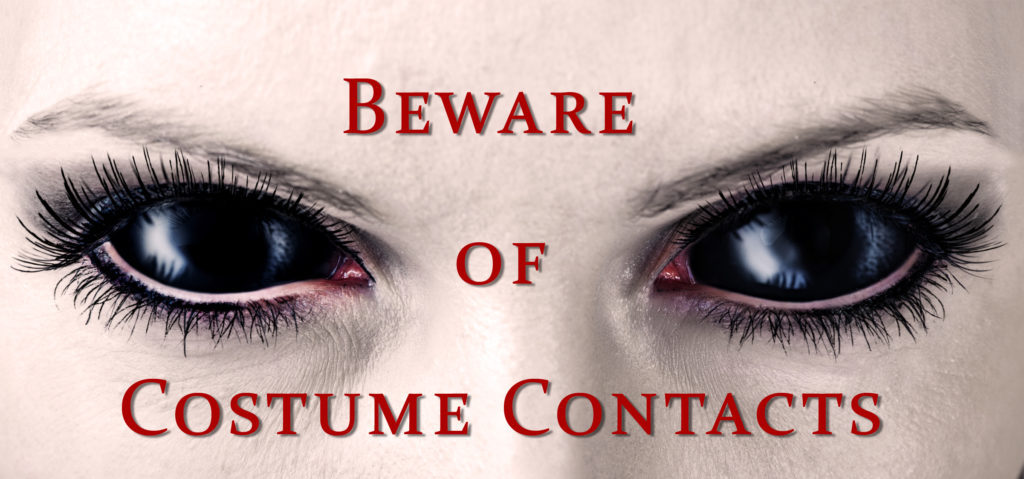
 Costume Contact Lenses such as cat eyes or zombie may make your Halloween costume a bit more frightful although wearing those lenses without a prescription can be more terrifying, as it could result in vision loss or even blindness.
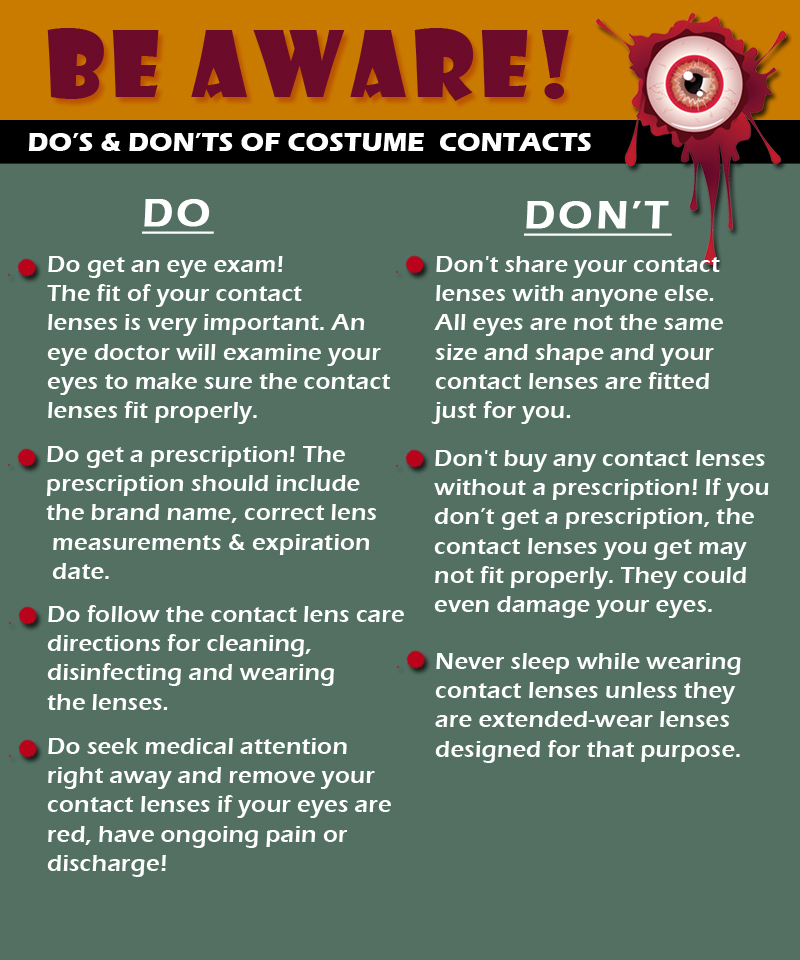
You can buy contact lenses, including decorative contact lenses, from your eye doctor or on the Internet. It’s very important that you only buy contact lenses from a company that sells FDA-cleared or approved contact lenses and requires you to provide a prescription. Even if you don’t wear corrective lenses you still need to get fitted properly.
Remember — Buying contact lenses without a prescription is dangerous!
Right now there are a lot of products that you can buy without a prescription but they may not be safe or legal.
You should NEVER buy lenses from:
- street vendors
- salons or beauty supply stores
- boutiques
- flea markets
- novelty stores
- Halloween stores
- convenience stores
- beach shops
- internet sites that do not require a prescription
Know the Risks –
Wearing costume contact lenses can be risky, just like the contact lenses that correct your vision. Wearing any kind of contact lenses, including costume lenses, can cause serious damage to your eyes if the lenses are obtained without a prescription or not used correctly.
These risks include:
- A cut or scratch on the top layer of your eyeball (Corneal Abrasion)
- Allergic reactions like itchy, watery red eyes
- Decreased vision
- Infection
- Blindness
Signs of possible eye infection:
- Redness
- Pain in the eye(s) that doesn’t go away after a short period of time
- Decreased vision
If you have any of these signs, you need to see a licensed eye doctor (optometrist or ophthalmologist) right away! An eye infection could become serious and cause you to become blind if it is not treated.
This Halloween season DEF wants to remind you of the importance of eye safety and to make sure to take the proper steps in ensuring the proper contact lenses.
 I could hear Charlie rubbing his wife’s shoulders and telling her that everything would be alright. But, Rose kept saying “I know we’ll have to sell the house and move into something smaller, and I am going to be blind Charlie. Blind.”
 Tom Sullivan
 Today, people are living longer than ever before so it’s important to be proactive and take responsibility for your health as you age.
 Maintain a healthy weight. Being overweight increases your risk for diabetes. By exercising regularly, you can help keep your body healthy and prevent vision loss.
  Don’t smoke. Smoking increases your risk for age-related macular degeneration, cataract, and other eye diseases and conditions that can damage the optic nerve.
 Wear protective eyewear when outdoors. Protecting your eyes from the sun’s ultraviolet rays when you are outdoors is vital for your eye health. Wearing sunglasses that block 99 to 100 percent of both UV-A and UV-B radiation.
 Know your family history. Talk to your family members about their eye health history. It’s important to know if anyone has been diagnosed with a disease or condition since many are hereditary, such as glaucoma, macular degeneration, and diabetes . This will help determine if you are at higher risk for developing an eye disease or condition.
 Consider a multivitamin. Vitamins C, E and the mineral zinc have been shown to promote eye health. Vitamins with Lutein and Zeaxanthin have been known to help patients with moderate to severe age-related macular degeneration.
 Give your eyes a rest. If you spend a lot of time at the computer or focusing at any one distance, you sometimes forget to blink, resulting in dryness and eye fatigue. Every 20 minutes, look away about 20 feet in front of you for 20 seconds. This can help reduce eyestrain. Consider using a lubricant eye drop during long periods of intense eye use and rest your eyes for 5 minutes.
 Tom Sullivan




 tic nerve, a part of the central nervous system that carries visual information from the eye to the brain.
 Many of us just use the basics on our smart phone and never personalize them for our own needs. It is worth taking the time to adjust our phones to take advantage of the special services that may be available and unused. Making a phone call or sending a text message with a smart phone can be challenging, however, with simple modifications, keeping in touch with the world can become a snap. Getting comfortable with your smart phone will make staying in touch with your loved ones very easy.
 Night vision can be impaired not only by the darkness, but also by the sudden glare of lights from oncoming cars, traffic signals, etc. Our eyes are forced to constantly adjust, leaving brief periods of impaired vision between adjustments.
 Discovery Eye Foundation is pleased to present the following excerpt from a just-released inspirational book called Walk in My Shoes. It is the result of two years of collaborative effort and is a unique collection of 27 powerful stories by individuals who are experiencing or witnessing the challenges of losing not one, but two senses: hearing and sight. The writers of Walk in My Shoes offer a glimpse into living with Usher syndrome, a progressive disease leading to blindness and deafness. Walk in My Shoes speaks to the more than 400,000 people worldwide dealing with Usher syndrome, to their families, to the professionals working with them, and to the rest of the world.
 ABOUT THE AUTHOR